
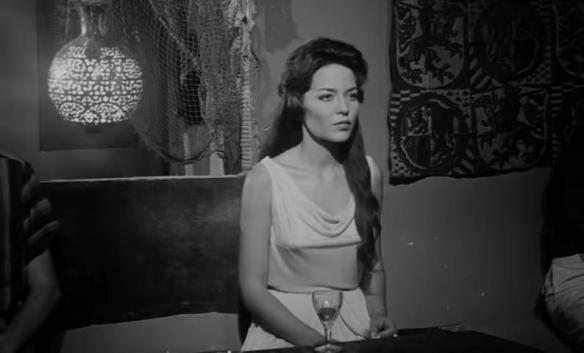
Sirens go off: A figure of speech, as it were.
 Spoiler Theater: In Curtis Hanson’s beautiful, haunting and unsettling romantic thriller, it’s a case of Boy meets Girl, Boy gets Girl and Boy, Oh Boy, does Boy lose Girl, But That’s Sort Of A Good Thing? Night Tide is a dark and moody film set by the Pacific, with an old pier carnival and its seaside surroundings as the main setting and what could be seen by some today as a few problematic elements in some of its troubled characters. I still think it’s an excellent film, mind you. But after watching it with a few friends recently, I see it’s also a film where some viewers applying more modern thoughts to its story may find an issue with their overall enjoyment. You’ll see.
A young sailor on leave named Johnny Drake (Dennis Hopper) goes to a seaside amusement park at night. He pops into a jazz club where he sees a lovely woman (Linda Lawson) sitting alone enjoying the music. He crosses the room, asks her if he can sit at her table because he can’t see the musicians from where he is, then proceeds to sit facing the woman, not the musicians. He tries to strike up more conversation, but she asks him to let her listen to the tunes instead. He then tries to buy her a drink twice, but she refuses both times. Suddenly, a strange, middle-aged black-clad woman (Marjorie Cameron) comes into the club, approaches the other woman and starts speaking an untranslated foreign language (Greek?) to her. The young woman is upset by this and quickly hands Johnny some cash to pay for whatever she was drinking and rushes out of the club.


 I’d forgotten Billy Wilder’s forever brilliant





 OK, I don’t “hate” The Three Worlds of Gulliver at all, but as a kid, it did take me four attempts to sit through this classic family film without falling asleep. Sure, Ray Harryhausen’s “Superdynamation” effects and that lovely Bernard Herrmann soundtrack make this another perfect one-two punch for movie fans, but something about this flick has always rubbed me the wrong way.
 Based on what transpired after it hit theaters back in 1960, one could almost say that career suicides don’t come any better or more stylish than acclaimed director Michael Powell’s Peeping Tom. Controversial immediately upon release in the UK, the film was banned for many years from public showings in some countries, but took on a life of its own as the years passed and is seen as a genre classic by many horror fans today.
 "DESTROY ALL FANBOYS!"