

Sometimes You Get It, Sometimes You Don’t Department: About a month back I’m walking to the subway from a press event and there’s this guy walking a cute bulldog (well, cute for a bulldog) who stops at a traffic light while a big truck is trying to turn the corner. As I stroll up next to them and wait the minute or so it’ll take the truck to make the turn, a gal in a nice summer dress pops out of a store, walks up to the guy and starts chatting about his dog, asking if she could pet it. He says “Sure!” and while she’s doing so, she looks up and asks “What’s your dog’s name?” The guy looks down and says “Murphy” and yes, I let out a huge laugh. The guy looks over at me as I’m recovering and I ask “Robocop?, to which HE starts cracking up. “Yeah, yeah…” Of course, as we’re having our chuckle, the gal is looking at us and not quite getting it. Right at that moment, the truck finished negotiating the turn and I noted to the guy that he might want to let the lady in on the reference before she thinks something crazy is going on. Of course, I had that Basil Poledouris theme playing in my head as I strolled off…
Oh yeah… nice poster, huh? I’m betting we’ll see a few more before this one’s ready for its close up.


 OK, I don’t “hate” The Three Worlds of Gulliver at all, but as a kid, it did take me four attempts to sit through this classic family film without falling asleep. Sure, Ray Harryhausen’s “Superdynamation” effects and that lovely Bernard Herrmann soundtrack make this another perfect one-two punch for movie fans, but something about this flick has always rubbed me the wrong way.
 It’s actually pretty fun to watch early 50’s to mid-60’s sci-fi films for their historical as well as entertainment value because the space race was in full blast and Hollywood was finding out fast that NASA was making most of what they were doing obsolete. Granted, other than the opening few minutes, Nathan Juran’s excellent First Men in the Moon doesn’t need to juggle much in the way of realism other than making sure its 1964 astronauts (made up of members of UN countries!) making that moon landing were wearing gear that at least looked up to date.
 When I was much younger, I wondered why Ray Harryhausen didn’t make more films until I found out how long it took him to design all those characters from drawing and painting some outstanding concept art to the construction and creation the visual effects. Let’s just say the man gained all the respect I had after that. That said, 1977’s Sinbad and the Eye of the Tiger is an example of what happens when a movie studio decides to rush things a bit too quickly, as it’s not his best work of the decade on display.
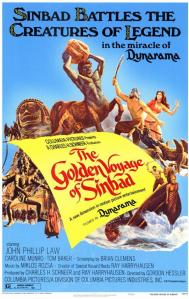 Ha! Motivation-killer flu, you can’t keep me from posting! Anyway, onward! It took Charles H. Schneer and Ray Harryhausen fifteen years to follow up their classic fantasy film The 7th Voyage of Sinbad with the second of three movies starring the fabled sailor and The Golden Voyage of Sinbad both looks and feels almost as timeless as that first adventure.
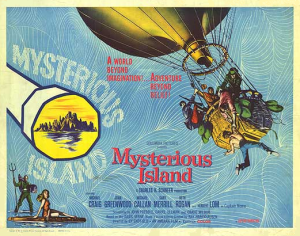 Yet another Charles H. Schneer/Ray Harryhausen production featuring a brilliant Bernard Herrmann soundtrack, 1961’s Mysterious Island is another classic fans of the master stop motion animator cite as some of his best work of the decade as well as a pretty solid genre entry. It’s certainly got a nicely varied cast of creatures going for it from a giant crab, an very angry and huge prehistoric bird, a few huge bees in their cliffside hive and a majorly over-sized cephalopod near the end. You also get a nice balloon escape at the beginning that gets most of the cast to that titular island, a few ladies tossed into the mix courtesy of a shipwreck and a surprise appearance by Captain Nemo that adds another layer of the fantastic to the film…
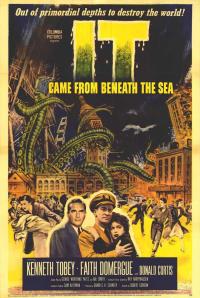 You can probably consider the 1955 film It Came From Beneath the Sea as (and I quote) “The ONLY six-tentacled giant octopus movie you’ll ever need” and call it a night, but this would be a pretty damn shorter than usual column. Actually, this was another fun Charles H. Schneer/Ray Harryhausen co-production put together to show off Ray’s stop motion animation brilliance and yes indeed, it succeeds quite well on that front.
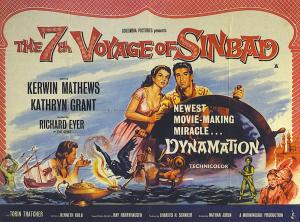 From the moment you hear Bernard Herrmann’s outstanding main theme that sets up the thrilling adventure ahead, director Nathan Juran’s The 7th Voyage of Sinbad sets itself squarely in fantasy film history as a true classic. Of course, having Ray Harryhausen on board and in full charge of the film’s effects work at the height of his talents makes this one an absolute must-see as well as one of the best genre films ever made. It’s a perfect blending of talents by all involved and it’s probably the one film Harryhausen worked on I’ve seen the most times as have many who’ve been influenced by it over the decades. This film was yet another hit for Harryhausen and producer Charles H. Schneer and also introduced the word Dynamation into the movie lexicon (later rechristened “Super DynaMation” and later, “Dynarama”), which amusingly enough, ONLY refers to the stop motion technique the master perfected over time and became an immediate means of letting his fans know who was behind the visual effects in that latest cinematic treat they wanted to catch…
 "DESTROY ALL FANBOYS!"