
(thanks, horrormovieshows!)
 After the successes of Godzilla and other Japanese and American giant monster movies in the 1950’s it seems that a few other countries wanted to get aboard the money train and come up with their own flicks featuring mutated reptiles or other gigantic beasts. Now, Denmark is the absolute last place I’d think of when I think “giant slimy lizard terrorizing the masses!”, but it seems that a combination of national pride and the over-eagerness of its Danish producers to make a big splash onto the scene brought the world Reptilicus … and TWO versions of it, to boot.
If you were a kid growing up in the US in the late 60’s and 70’s, this one was a staple on a few TV channels across the country, popping up either in the afternoon or evening and sometimes late at night to not scare you at all. In fact, I can recall seeing this as a kid and being baffled, then bored, then amazed at how bad and cheap the movie looked, but still watching it to the very end each time…
Continue reading


 For some fans of giant monster movies, Godzilla is their gold standard, but I’m a Rhedosaurus man, myself. 1953’s The Beast From 20,000 Fathoms is a smaller-scale picture when compared to Toho’s epic genre entry and it’s also not as sprawling and dynamic as King Kong in terms of impact. On the other hand, Ray Harryhausen’s work here is superb and at a mere 80 minutes, this one goes down easy and doesn’t wear out its welcome one bit.

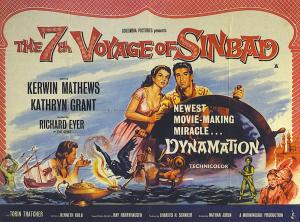 From the moment you hear Bernard Herrmann’s outstanding main theme that sets up the thrilling adventure ahead, director Nathan Juran’s The 7th Voyage of Sinbad sets itself squarely in fantasy film history as a true classic. Of course, having Ray Harryhausen on board and in full charge of the film’s effects work at the height of his talents makes this one an absolute must-see as well as one of the best genre films ever made. It’s a perfect blending of talents by all involved and it’s probably the one film Harryhausen worked on I’ve seen the most times as have many who’ve been influenced by it over the decades. This film was yet another hit for Harryhausen and producer Charles H. Schneer and also introduced the word Dynamation into the movie lexicon (later rechristened “Super DynaMation” and later, “Dynarama”), which amusingly enough, ONLY refers to the stop motion technique the master perfected over time and became an immediate means of letting his fans know who was behind the visual effects in that latest cinematic treat they wanted to catch…
 "DESTROY ALL FANBOYS!"