(thanks, Cinedelica TV!)
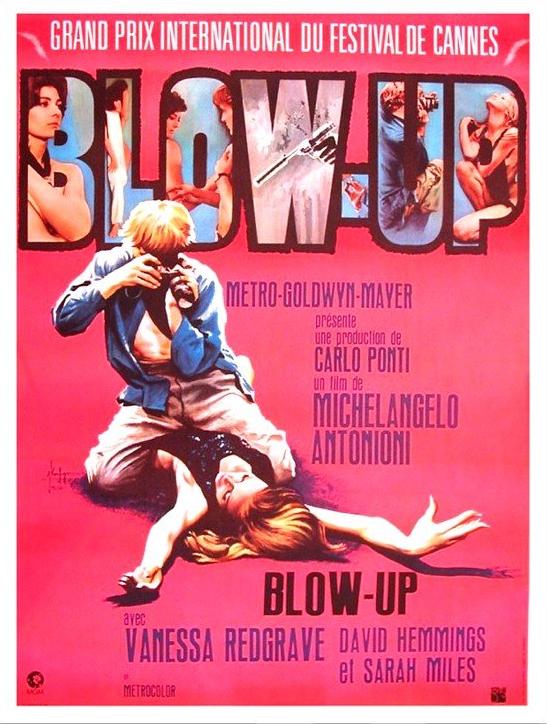 “Nothing like a little disaster for sorting things out.”
Some people hate Michelangelo Antonioni’s groundbreaking 1966 film Blow-Up (or Blowup depending on how you prefer it spelled, I go with the poster myself) with a passion reserved for cruel dictators and people who drive vans full of puppies and baby rabbits into lakes. Me, I’ll admit to disliking and being frustrated with the film when I saw it as a not quite ready to see something so heady teenager thinking it was going to be something entirely different. However, as years have passed and I’ve seen it a few more times, I’ve come to truly appreciate the film for the things it nails while realizing most people who despise the film tend to over-analyze it to the point of making themselves confused as to exactly what the movie is about.
For all its swingin’ London scenery, excellent use of that great Herbie Hancock score, skinny exotic models posing for a seriously unlikable main character and seemingly “boring” stretches where seemingly, nothing important happens for some viewers looking for a proper narrative before something important DOES happen (that’s picked upon as important to those plot followers, naturally). The funny thing is, any attempts as locking in that golden “Aha!” moment are interrupted by a few distractions that intentionally take focus away from things unless you’ve clued into what’s actually going on here. With all that, Blow-Up is actually a surprisingly minimalist and easy to understand film, albeit an experience that demands your complete attention. Well, once you cut through the arty fat and get to the hidden in plain sight meat on the bone dangling in front of you, it’s a more fulfilling viewing experience. On the other hand, it’s also a film that while open to a few interpretations, still revolves around a central theme some continue to overlook.
The first chunk of that fat just so happens to be the gorgeous look of the film, from the production design, sound, costumes and so much attention to detail about the work habits of a successful fashion photographer (David Hemming) who’s great at what he does, but not the easiest person to work for or with. He’s the second chunk to deal with as he barks orders at his models, walks off a set when he’s not getting the shots he wants and in general, treats the young ladies he meets pretty damn poorly. His jaded nature about his model shoots and models is a counterpoint to what seems like one actual passion where he’s pleased with himself: taking photographs of random people around London for a non-fashion book he’s working on. Score one for meat if you’re paying attention, by the way.
I can recall seeing this for the first time and being baffled by the scene where the photographer pops into an antique shop and ends up buying a ridiculous and large airplane propeller for his studio and then trying to fit it into his flashy car (a Rolls Royce convertible which has two-way radio/phone in it). Of course, it’s too big and requires a delivery, arriving at a key moment in the film that you’ll hopefully take a mental note of. I’ve watched this movie with friends who are bored by the slower moments or who don’t “get” what’s going on because they’re too wrapped up in how much of a sexist jerk Hemmings makes his character. All of these end up as very important intentional clues and cues in a film that makes use of repeated elements from different angles.
(thanks, Rafael Sordili!)
It’s not too long afterward on one of these photo-taking strolls that our anti-hero ends up in Mayron Park snapping a few pictures of a man and woman (Vanessa Redgrave) together from afar. The woman sees him and shocked, tries to wave him off to no avail. Chasing him down, she demands the film, but the photographer blows her off and leaves. During a stop for a meal, he finds out he’s being followed and not soon afterward, the woman comes to his studio and tries again to get the film, even going as far as to partially disrobe and make an attempt to hop into bed with the photographer. Well, he wants to much more than she does:
Photographer: Don’t let’s spoil everything, we’ve only just met.
Woman: No, we haven’t met. You’ve never seen me.
Obviously intrigued and aroused, out shutterbug tricks the woman by handing her a different (blank?) roll of film, gets her to write her phone number down and they part ways, each thinking they’ve scored a major victory.
It’s here that more of the fat falls away and the juicy flesh appears. Antonioni has been keeping your eyes and brain busy and overloaded until this point, but here, he peels back the dialog (which in this film isn’t that important at all) and shows the photographer uncovering what looks like a murder as it happens. The scenes where he develops the film, thinks he sees something and starts blowing up images and tacking them to his walls are brilliant, played without any sort of narration or the usual Hollywood fakery of an actor telling you what you’re seeing with your own eyes. As he enlarges and sections off bits of a few frames, things click into place and we see him not only realize it, but break the silence after that click to make a phone call. However, he makes the mistake of thinking he’s prevented a murder (and making us believe he’s a sort of hero for a brief moment).
At this point, Antonioni pulls a grand trick on the audience by re-introducing two girls seen much earlier in the film, aspiring models (Jane Birkin and Gillian Hills). They show up unannounced and the photographer slips into habit and ends up stripping them (and they him) roughly and having (off-screen) sex. Afterwards, as he’s recovering, staring at the photos of the woman and mystery man still tacked on his wall, he sees something he didn’t previously, brusquely orders the two girls out of his place promising to snap pictures of them tomorrow and gets back to more cropping and enlarging. He ends up with a series of shots that show the couple from afar, the couple holding each other with the woman looking anxiously in a certain direction (before noticing she’s being photographed), someone in the bushes to the left of the couple holding what looks like a pistol with a silencer on it and in the last image, a somewhat blurry shot of what might be a corpse partially hidden behind some bushes. Bingo. Maybe.
But, probably due to his newly found excitement at actually seeing something he shot that not only surprises him, but makes him feel better than he’s felt in who knows how long, our non-hero makes a beeline for the park to the spot in that enlargement and yes indeed, sees that body up close and personal. Without his camera. Oops. It’s here that some viewers suspended belief falls to the pavement and shatters, if not for the camera thing, for the fact that the half-hidden body has remained undisturbed for hours. Granted, one can defend this by saying it’s a huge park that way back in 1966 London wasn’t patrolled by police like many public parks are today. This is my theory, as is the fact that had the body been moved, the rest of the film would be needless.
Anyway, arriving back at his studio, Antonioni distracts the audience once more with sex, courtesy of the photographer’s neighbors having at each other with a window open. It’s an odd scene because the woman (Sarah Miles) sees the photographer watching them and he stands there expressionless, watching for what seems a wee bit too long. She raises her hand and motions for him to be silent and the camera drifts to the floor and up to a spot on a wall before going back to the photographer finally walking away and upstairs to his space. No sooner than he arrives upstairs, the photog sees his place has been ransacked and all but one of the enlargements is gone. Interestingly, it’s the fuzzy image of the corpse that’s left behind as if to taunt the cameraman as to trying to convince anyone that it’s a dead body.
Another distraction: the woman comes upstairs and blandly asks if he was looking for anything when he was spying on her. To me, this suggested that the two had either been briefly involved or the woman at one time desired him but nothing came of it. She disappears right after that, rendering the scene insignificant but interesting because you may be wondering why she didn’t get asked if she saw or heard anything going on upstairs (although she may have been otherwise occupied). Back out on the street driving around, the photographer sees what looks like the mystery woman standing on a street corner near a small crowd. She turns and vanishes into that crowd and when our man chases after her, he ends up in yet another distraction:
(thanks, Poseida de la baba!)
I won’t even explain this scene because it’s just one more that many get hung up on. Between the initially jaded audience (save for a distinctively dressed dancing couple) that turns into a screaming mob once a guitar is destroyed and the photographer ending up with a souvenir from his detour he discards (and watch what happens once he tosses it away), it’s just there to keep your brain busy away from the message you should have received a while back. The director hits you again with a return to the park to see the body is no longer there and no one around asking questions.
After a trip to a party where everyone’s smoking marijuana (save for the photographer, who tells someone what happened, but it goes nowhere because the guy he talks to is too loaded to care) the film ends with an ending that’s somewhat similar to its opening but with the photographer now seemingly given up on his chase for the truth. Walking around an empty park after discovering the body has been moved (or never was there if you choose that path), he’s drawn into a fake tennis match played by a group of mimes before he retrieves and throws back an imaginary ball then simply vanishes in a long shot. The film ends with its mystery unsolved if you were looking for a resolution to that particular red herring and then, if you’ve watched this with others, the conversation will start off (and usually lead to discussions on how “bad” the film was for being so damn stylishly shot and edited).
The murder (or “murder” if you don’t see or agree with what the photog sees) isn’t the key at all, nor is the photographer’s shameful treatment of his models and other people during the film. Antonioni shows us a man who’s more or less a walking stereotype who comes alive when he believes he’s burst out of his version of a routine existence. If the film was scripted with and Hemmings was cast as any other profession, it wouldn’t make a whole lot of sense (or less sense than it does once you see it for what it is) unless he was an amateur taker of pictures with his own darkroom. But as a photographer for job and hobby purposes, we see him going through the motions in his regular work, but with the crime he thinks then knows he sees, his reason for living and his work process become important again. Well, right before all he’s uncovered is taken away save for the one image he can’t prove exists because the actual physical evidence is gone.
Of course, your own mileage will vary with this one, especially if it’s your first time and you try and see this as a straight narrative. In that case, you’re on your own, but I’ll suggest staying away from being too hard on this classic until you put a few views under your belt and stuff starts clicking away in your own head…

 "DESTROY ALL FANBOYS!"
I really love this movie. I’ve only seen it once, but the imagery stayed with me ever after.
LikeLike
I first watched this when I was about 14 and, reading your post, I realised that his was the movie that made me really love film. I think that has a lot to do with the ’empty space’ where – as you mention – nothing really happens. It made me realise that films don’t have to be synonymous with lights, camera, action, that quietness is ok too. Maybe I’d just been bought up on a bad diet of Hollywood trash, but this led me to discover a whole new world of film – including classics from the Golden Age – and a new way of thinking too. I bet if I watched it now it wouldn’t have the same impact, but that’s not really the point!
LikeLike
It’s such a fantastic film because some people see it and ONLY focus on what they know from other films and completely miss out on the stuff drifting by that’s where the spirit lies. You CAN see it as a murder mystery that goes unresolved and get some satisfaction that way (or no satisfaction if you wanted everything wrapped up in a neat CSI-like bow), as some sort of look at the fashions and music of the era (if you choose to ignore the story and focus on the cool things). But it’s absolutely worth a few views over many years because when it finally “clicks” as to what’s taking place, there’s a feeling that may be close to what that photographer feels when he sees what he wants to see in those images.
Of course, I think there was a death and that was a real body he saw – how and why it vanishes is unimportant as we never see him look at a newspaper or watch the news afterwards. If there was some importance to all he saw, it’s vanished like he does at the end of the film…
LikeLike