
 When 2001: A Space Odyssey set the bar for visual effects back in 1968, movie studios around the globe kept trying to reach that level of polish and for the most part failed miserably. Outside of a few major and minor sci-fi hits and misses in theaters (Marooned, Journey to the Far Side of the Sun and Silent Running pop off the top of my head) and on TV (those bits of Gerry Andersen’s UFO and Space: 1999 that work), it wasn’t until the release of Star Wars that a major studio film had a visual aesthetic genre fans could glom onto almost universally for sheer “wow” factor. Granted, when Logan’s Run was in its production phase, I’m betting it sure looked “futuristic” to the very hard working teams building that huge model of the city and domes, the set and costume designers and yes, the visual effects crew, actors and director. Hell, it certainly impressed the Academy of Motion Picture Arts & Sciences, as a special Oscar was awarded the film at the 1977 Academy Awards. Of course, George Lucas and ILM made that award all theirs the next year in a film not predicted to do all that well by a few people (Lucas included)…
Still, that didn’t help matters much in my case, as even as a wee bairn of eight years of age, I knew Logan’s Run was going to be enjoyably junky thanks to the TV commercials and rainbow on those posters I saw in subway stations. Interestingly enough, it actually popped up on TV about a year later (an amazingly fast time for a major Hollywood film), and while I was fascinated by some elements, to my mind it still looked cheap and the story (which I didn’t know was even more edited for TV) was hard to follow. Naturally, even though I didn’t like the film much, I ended up watching every episode of the 1977-78 CBS TV series and just like what happened with Planet of the Apes on the network, it managed to be dumber than the film, but easier to follow once I figured out that nothing would happen to the leads because they needed to be around for next week’s show. But I digress…
I’ve seen Logan’s Run perhaps thirty or so times (perhaps more, as I’ve never counted, but I’ve definitely made time to see it when I found out it was on and I was near a TV) since over the years and it’s less terrible than I recall, but still stupid in some spots and intriguing in others. I’ve never gotten over the fake-looking (but yes, impressive) massive city model, but I appreciate the perfect city filled by entitled (but doomed) youth element a lot more over time. That these sections were partially shot in an actual mall that “looked” futuristic (well, by 1975 standards) adds to the semi-cool factor, but somewhat uncool (and amusingly so) is how Anglo-centric the casting seems to be. Even with a facelift joint that can transform citizens into anyone (as long as that New You looks under thirty, that is), I think Farrah Fawcett-Majors has the “darkest” skin tone in the film, but even she gets killed off after hitting the audience over the head with a block of wooden “acting” before getting hit on the head herself by some heavy ceiling material or whatever.
Yes, the male principals are cast for their looks (Michael York and Richard Jordan are handsome non-chunky hunks you rarely saw as action hero types ten years later in the Schwarzenegger/Stallone age) and anyone not mooning over Jenny Agutter is wearing a blindfold (or not watching as they’re beating their significant other over the head for doing that mooning). But when the only “person” of color is a robot voiced by the great Roscoe Lee Browne (and probably partially portrayed by a stuntman in that Dalek meets mannequin and old vacuum cleaner parts costume), the critical eyeball hikes up its skirt and shows more than an ankle. What, were all the minorities were eaten as Soylent Green or something years earlier? or maybe they just happened to all get sent to Carousel first because of their skills in dodging faster than the current residents? Inquiring (and snarky) minds want to know!
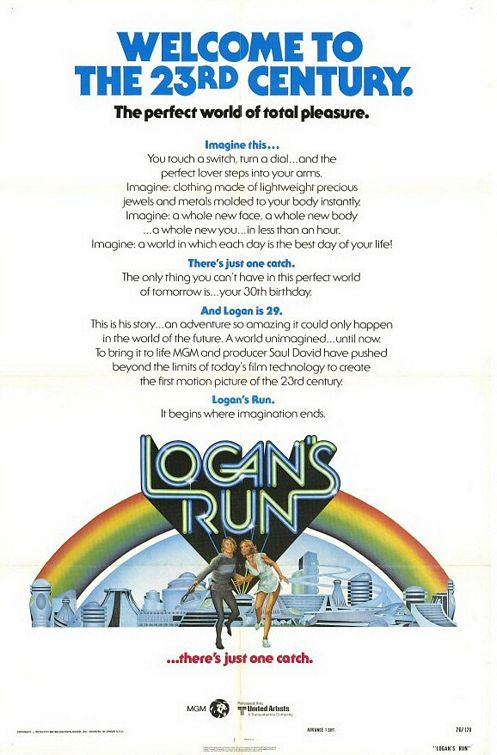 I’ve read some criticism of the film at some of the plot points such as why weren’t the rest of the Sandman notified that Logan was “aged” up almost four years as part of his assignment as a “runner” and told to pursue but NOT try and kill him, but even the alternate poster for the film makes an oddball mistake in stating he’s 29 and not 26. Perhaps that’s just a really clever fake-out by whomever came up with the copy, but I doubt it. Other stuff is just goofy and seems dropped in to keep things flowing or because they built that damn big set, so it may as well get used in a scene manner. The Box sequence really comes off as odd unless you just give in and say “that robot so crazy!” as he explains why he’s there before trying to do in Logan and Jessica and make them part of his art collection. If you consider he’s probably nuts from a combination of lack of regular maintenance and possibly being bored and cold down in those caves, I guess his insanity makes sense. Then again, I can recall the book being much more enjoyable than the film was, but I didn’t read it until I was about 11 or 12, so I had to live with years of cracking up at the sequence in the film because it was quite batty (and I don’t mean Roy, either).
That clip above with some scenes that didn’t make it into the final film is interesting because it’s clear that this is one movie that would have benefited from more editing OUT of stuff left IN the final cut. I didn’t mind the nudity at all, by the way. Given that it was chopped from the TV version and by the time I saw the theatrical version, I considered it arty background “noise” and felt it made sense in context of the permissive society on display. Hell, you can throw up a cloud of pink drug dust in the air at home with the ladies or men you rent for the evening and it’s instant orgy! Take that, expensive cocaine or other drugs that only get you “friends” who want your drugs and wouldn’t go near you in real life unless they were already stoned, woooo!
I’ve always liked the Carousel sequence because you do buy into the “renewal” thing and it’s pretty well shot (visible wires aside), but you have to ask yourself if everyone is high on that drug dust or just forgetful that no one survives the circus and pops up as renewed? I guess there are so many people in the city that one doesn’t know everybody… but doesn’t anyone have a friend who went up and never returned? “Say, whatever happened to Bessie Eleven and Rex Nineteen?” (long pause) “Um… oh, who?” Well, given that in the book the age for termination was twenty and not thirty, I guess it must be the drugs after all as I certainly knew more as I got older and not less. Then again, this is a movie where the central computer system running everything blows itself up when it has a hissy fit that’s a lot less stressful that today’s blue or lack screen of death to one’s computer at home or work. Damn thing gets hung up on a fact it can’t digest and *FOOM!* There goes the neighborhood.
So why do I keep watching this film when I can? Oh, I still wonder about that each time. Perhaps it’s the film getting better looking visually outside the domes and how Jerry Goldsmith’s fantastic score goes from buzzy and futuristic to more organic and atmospheric in spots? Maybe it’s Peter Ustinov’s part as the only person over thirty, a slightly crazy old man who’s a fount of knowledge yet uncomfortable around people (note the scene when he’s seen by the citizens who survive the collapse of the domes and one girl touches his face and beard). Or maybe it’s that I watch it and want it to be more than it is, filling in spots that fail with ideas I’ve thought up over time and now don’t need to do so now that Irrational Games’ Ken Levine is writing up a script for the remake? That’s mind-blowing in and of itself and I’ll bet Ken would love to know (or already knows) that Jenny Agutter is still around and might be a nice addition to that sequel. Perhaps a re-writing of the Ustinov part to reflect a female point of view would add a nicely maternal touch to things?
We shall see, I suppose… we shall see…

 "DESTROY ALL FANBOYS!"