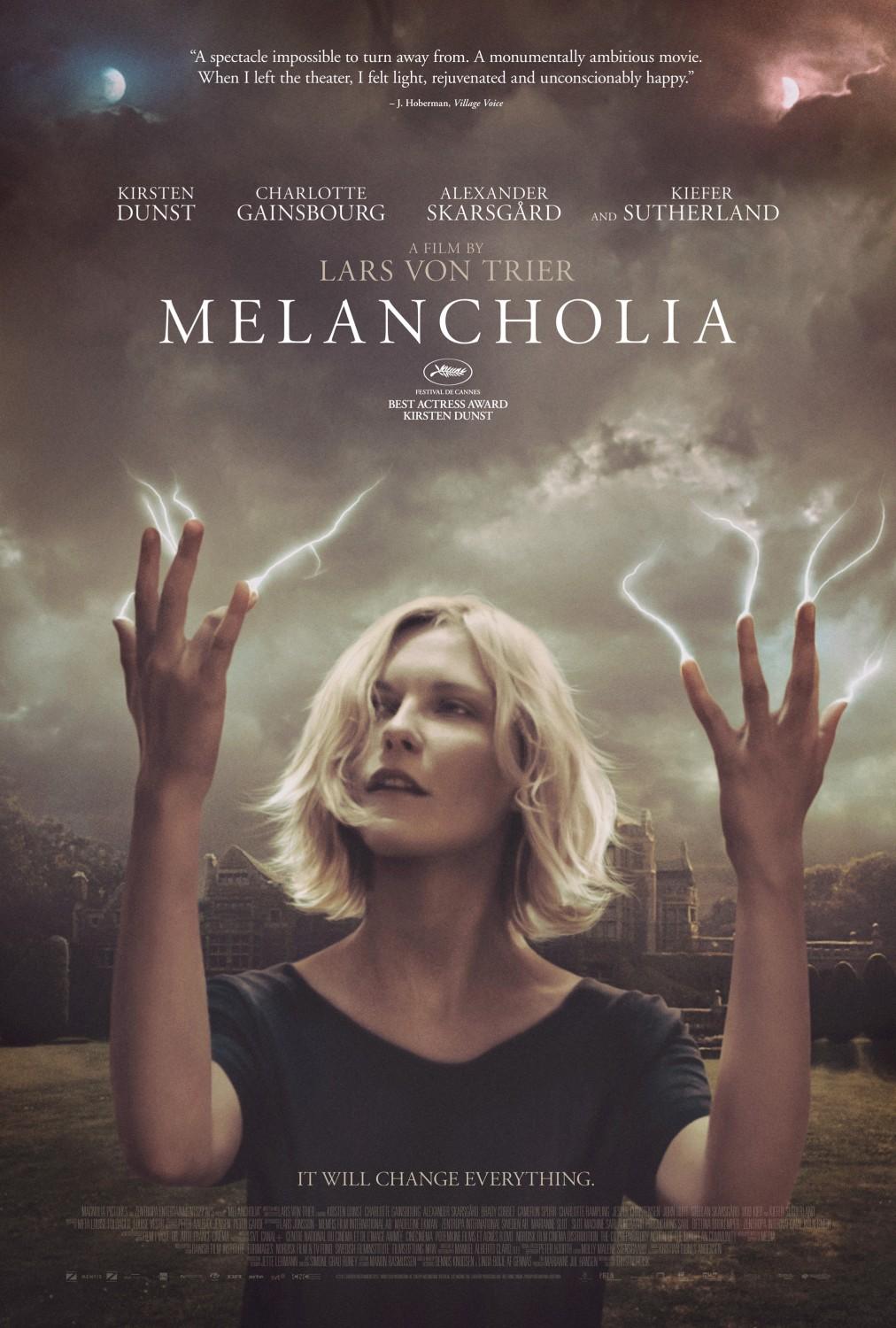
 Quite possibly the best end of the world movie to date (provided you aren’t expecting something along the lines of an Irwin Allen-style Hollywood blockbuster packed to the gills with overpaid celebrities), Lars von Trier’s Melancholia is also a surprisingly beautiful film despite the fact that everyone dies at the end. Er… Surprise!
Actually, the film spells its not so big secret out in the stunning opening montage and its two acts play out in operatic fashion as things unwind in the lives of two sisters and how they deal with the impending disaster. Even though you know what’s going to happen, von Trier’s focus on the pair and the more intimate events in their small part of the world makes for compelling viewing that keeps you watching until the very end. Even if you don’t like some of the director’s previous films, this is one of those essentials that’s not as depressing as you’d think thanks to some excellent performances all around and some truly gorgeous cinematography.
Kirsten Dunst and Charlotte Gainsbourg are Justine and Claire, and the film is split into two chapters focusing on one part of each sister’s life. Justine’s portion of the film shows her wedding day as it goes from happy to silly to sad over the course of a long evening. Late to the reception thanks to a too-long stretch limo (the most amusing part of the film), Justine is at a crossroads in her life and the wedding party brings all her problems to light, forcing her to retreat into depression and rebel through a few drastic means. By the end of the evening, her new husband has left her, she’s done some odd things and Claire and her spouse, John (Keifer Sutherland, thankfully showing he’s no longer in Jack Bauer mode) are none to pleased by all this. Here, the planet Melancholia isn’t seen or discussed at all, but at two subtly played key moments, Justine notices a faraway star has appeared, then disappeared. Her own deeply rooted troubles eclipse this, of course… for the moment.
The film cuts to Claire’s story as Melancholia has become news worldwide with debate among scientists stating the planet will fly by earth safely and doom-sayers predicting it will crash into earth after revolving around the planet, destroying everything. Justine’s mental state has had its own crash and she moves in with a concerned Claire, John and their young son. Initially, she can’t even bathe herself and refuses to eat much, but when she finds out about Melancholia, her depression vanishes as Claire’s starts to appear. von Trier nicely plays with some repetition (a stunning horseback ride shot from Justine’s chapter is redone in Claire’s with a slightly different outcome) and the film manages to flow carefully and confidently to its ending as both sisters’ emotions go in wildly different directions.
Even when she’s at her lowest point, Dunst is radiant and revealing. Forget about her work in those Spider-man flicks – she can act and it’s hard to take your eyes off her. Gainsbourg is also special and the pair’s scenes together and with the other actors flow naturally thanks to improvisation that lends a sharp realism and absurdity to the wedding party’s slow decent into strangeness and a growing sense of realization to the quieter scenes afterward. By keeping the focus on the sisters and the few people around them in the second chapter and bringing Melnacholia to its different points in the sky, von Trier creates a nice tension that actually becomes a comfort zone of sorts as the sisters deal with a few loose ends before the world literally comes crashing down on them.
While it’s entirely possible to over analyze and pick the film into minute by bits for discussion, it’s not at all necessary. Justine’s slide into depression is never fully explained in her chapter, but all you need to do is pay attention to her mother (a bitter, sharp tongued Charlotte Rampling), father (a loopy, scattered John Hurt) and Claire to see where part of her problems come from. Granted, her boss pressing her to deliver some ad copy during his congratulatory speech and a few other pressures internal and external make Justine a sympathetic character, but if you’ve never been depressed (and you’d be lying) you may also dislike her at first for rejecting happiness for withdrawal. Then again, what works so wonderfully about Melancholia is you know right at the beginning that none of this truly matters by the end. Even if this was a purely happy movie, there’s that blue planet looming above all else waiting to erase any sort of feeling anyone has when it hits.
I say double this up with another doomsday flick such as When Worlds Collide (or if you want something much lighter and funnier, The Hitchhiker’s Guide to the Galaxy), break out the popcorn and maybe a hanky if you tend to get weepy or sneezy and make a night of it. Maybe invite a few doomsday-believing buddies over who might still be licking their wounds from not getting their holiday gift and let them at least get a look at what they missed (if you don’t mind that sort of company). That hanky will get used at some point, guaranteed…

 "DESTROY ALL FANBOYS!"
Pingback: Random Film of the Week(end): When Worlds Collide | "DESTROY ALL FANBOYS!"