
“Any resemblance to real events, to persons dead or living, is not accidental. It is INTENTIONAL.”
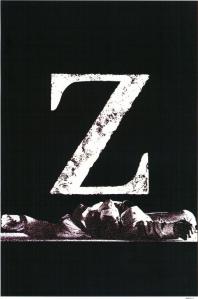 Sure, today’s political climate here in the US is damned awful to the point of it better to have the country be run by a pack of brainy hamsters with suitcases, but at least we’re not quite in Costa-Gavras territory (er, well… outside of illegal detentions, torture and secret trials, but hey, let’s skip that for the moment). “Loosely” based on actual events, his 1969 film, Z was (and still is) a pretty powerful piece of movie history that’s essential viewing for anyone who thinks the political system here has gone too far off the rails. It has (and how, thanks to too many ill-educated, power-mad people allowed to run for, win and hold office without proper vetting), but things aren’t quite as horrific as they were in Greece around 1963. Although the film doesn’t set an exact time or place, that quote above is placed before things get rolling and if you’re a good enough student of history (or can use the Internet properly) it’s easy to figure out that this isn’t just your run of the mill thriller…
After an intentionally slow (but fascinatingly precise) opening, the film drops viewers in on a political rally where things go not exactly as planned thanks to an assassination attempt made to look like an accident. As shocking as those moments are, the cover-up that follows as well as the hope the director allows the audience that things will be resolved through legal means are even more disturbing. We see a system rotten to the core and filled with worms wearing uniforms that should be respected. But a culture of corruption only punishes those who try and peel away the bad parts when they should be cutting down the entire tree and pouring lime onto the roots. By the time the closing credits roll (complete with an actual list of things banned by the Greek government including the Beatles, free press, and yes, the letter Z), you’ll probably be pretty ticked off at something, but not because the film is anything resembling bad. Costa-Gavras does such a magnificent job with his almost documentary-style direction that every second of the film is important. Additionally, a great score by Mikis Theodorakis helps drive the action along from start to finish.
While the film was quite controversial in a few places outside the US upon its release, it did manage to win the Best Editing and Best Foreign Language Oscars in 1970. However, the director wasn’t about to become yet another Hollywood darling making silly action and romantic comedies on a contract basis (not by a long shot either, as films with Hollywood stars such as such as Missing and Mad City later revealed). Amusingly (or not so amusingly) enough, the director’s 1972 film, State of Siege managed to be somewhat more controversial here in America thanks to its urgently testy subject matter about US intervention in Latin America (among other unsettling things).
Normally, I’d say rent and watch both of those films back to back, but then again, that’s only if you want to feel really depressed and angry afterward. You may want to drop a good silly comedy somewhere in there to lighten the mood a bit. Or, if you want something in a similar vein that has a lot more in the way of black humor (and makes for yet another interesting take on corruption in authority), I’d highly recommend another Oscar-winning Best Foreign Language Film, Elio Petri’s outstanding Investigation of a Citizen Above Suspicion. For some reason, this 1970 classic hasn’t “officially” hit DVD or Blu-Ray from what I can tell (there are foreign copies of dubious origin floating around auction and movie trade sites), but it occasionally pops up on Turner Classic Movies (TCM). OK, enough education for the day – it’s too hot today to get some of your brains percolating this much, right?

 "DESTROY ALL FANBOYS!"