
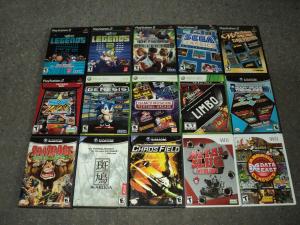
 One of the annoying trends I’ve seen grow far out of hand over the last decade plus is the issue of griping about longevity in games, or more precisely, the overemphasis on criticizing length versus cost divided by quality. Pop onto any games review site or message board and you’ll see whining about games being too short for what they cost (no matter what they cost) or worse, too many posts about people who play certain types of games ONCE and immediately trade or resell them, often for far less than what they paid. This is dumb, and thanks to too many reviewers who write as if they’ve never set foot inside an actual arcade (or even if they haven’t, fail to understand that most games are made to be replayed), this trend of limited thinking and under-appreciation will keep thriving. For me, unless a game is so terrible that it HAS to be removed from one’s sight as soon as possible after a single play-through, it’s worth replaying… and in many cases, keeping.
That said, I’ve also kept some truly awful games around just because I dearly WANT to complete them just so I can try to understand everything that went wrong (I’m talking to YOU, Muzzle Flash) Yeah, yeah, to some of you, a bunch of the games in that photo (made up of random titles I grabbed from my collection) “suck” or are games you haven’t played because you’ve never heard of them or don’t like whatever system, genre or who knows what other bias you’re afflicted with. What’s important about each and every game there as well as almost any I’ve ever played and enjoyed since 1972 is that at some point, I’ve played them again. Maybe not right away, but I do go back to quite a lot of older titles the way some people revisit a favorite book. Too many of today’s gamers seem to think that if a game is “only” a few hours long (or minutes, in the case of many arcade games) and linear, it’s a “bad” purchase. No matter how good it is, if they can complete it in one sitting, it’s somehow “lacking” in depth or challenge simply because of this “one and done” mentality. Revisiting a game I’ve blazed through a few weeks, months or years later is actually great brain and reflex food as well as a nice trip down memory lane if the game was fun the first time.
I’ve been around since pinball and the Magnavox Odyssey and yes, while the majority of console games back then and up to the NES had no endings as we know them today, they had more than enough replay value for a few reasons from beating a high score or showing friends how cool a game they may have missed was. These days, nearly every game is treated as disposable thanks to gamers who don’t care about the work that goes into them and critics who should be educating the less informed about this, but fail to do so in spectacular fashion. Of course, it’s easy to dump on old arcade or console games, but isn’t it interesting that multiplayer-focused shooters and yearly sports franchises that are hugely popular ALSO revolve around short sessions and getting the most out of a single purchase?
And don’t even bring graphics into the picture as an argument. The “retro” trend has been a huge part of many indie and major game appeal for years now and in fact, has never really gone away. When the 8-and 16-bit eras were dead and gone, there were plenty of fans of those old games keeping the flame alive through are, chiptune music and yes, new games, homages or unofficial remakes that had the look, sounds, “feel” and appeal of those older classics. Sure, paying fifty or sixty dollars for a three or four hour game is a bit crazy… until you consider that back in the 90’s that’s what we were paying for games that didn’t last half that long. Granted, while pressing a disc-based game costs less than a cartridge, development costs for games have skyrocketed, making shorter game experiences seem less palatable to many.
Still, it needs to be said that there’s a place for licensed movie games IF they’re good, as well as arcade-like games that are well-made enough to stand out among the crowded digital marketplaces. If every gamer and critic used the same irksome barometer about longevity for every PSN/XBLA/indie download, there probably wouldn’t even be any sort of marketplace for these titles. Or at least the higher-quality games would all be a lot cheaper because they’d be judged on how long it took to play them over anything else. As for retail games with more multiplayer than single player content, for me, it’s a no-brainer that most games that focus highly on MP need a solo play mode for the simple fact that sometimes, players can’t get online when they want to. That and hell, it’s just great to see a game that’s more than a bigger, louder version of last year’s version because the dev team wants to see what they can do with narrative outside of “kill everyone, yell at teammate on headset” with a few tweaks here and there.
I’m typing this article quickly while Disney/Pixar’s Brave: The Video Game is paused in the other room. I got PS3 and DS versions to review earlier and after a bit of time with each, I can safely say that both are well-made and surprising for a few reasons I’ll cover in my reviews. I’m about halfway through with both games and yes, they’re not the longest games I’ve played by a mile… but they’re both FUN in a “I think I’ll play this again!” way most arcade or other classic games I like are. They’re both premium priced titles, which will be a sticking point for a few budget-minded gamers or people who demand that games with high price points get stuffed to the gills with content. Licensed games like this aren’t for those “core” gamers at all, I say. They’re usually made for the folks who go see the film, love it and want to extend the experience with something they can share with the kids. I’d gather these folks are buying games every week or month, so that premium price isn’t a big hit because it’s more of a treat than a regular thing.
Some of these consumers may choose to rent the PS3 or 360 version and end up buying it later on because it’s a case where the kid(s) it was rented for never completed the game or completed it and wanted to replay it again and again. I’m gathering Disney knows the game’s price might be an issue, so they’ve actually added a voucher inside the package for a free movie ticket to Brave, which isn’t a new idea, but a nice thing to do that acknowledges the game’s MSRP. Granted, if you’ve already seen Brave, that free ticket might be seen as a bit after the fact. Then again, the game did hit retail a few days before the film, so you’d have to had your little whippersnapper hitting you up for it in order to take full advantage of that freebie offset.
Anyway, I’m going to shut up now and get back to the game, but we’re in some sorry times when some games keep getting knocked down because they’re not being gauged correctly, no matter what they cost. As I’ve said before, a good game is like a good book (or any good relationship) – you’ll try something out and keep what you like around because there are things that make you feel good about them. Of course, this is an opinion piece and yes, game criticism is opinion as well. Unfortunately, we’re in the era of over-reliance on aggregate sites, too many “angry” reviewers with more passion for their egos than the games they play and just plain lazy writing because some folks want to get back to their MMO, shooter, fantasy sports or hot chick in a bikini fix.
At this rate, I have no idea where things are headed, but if they don’t start changing before this next generation of consoles gets underway, it’s going to be one where too much cynicism destroys much of what makes gaming a blast to guys and gals like me. going forward, I’ll try to give you my fair take on games I review from the perspective of someone who “gets” what a dev team is trying to accomplish (in terms of their actual games, not a publisher’s overall business plan) and we’ll see what happens. As it stands, between the wild over speculation, rumor frenzies and short attention span theater that passes for some games journalism these days coupled with too many gamers who just don’t understand that there’s more to most games than blowing through them as quickly as possible, it’s going to be a hard future for developers as more and more players stop respecting just what it takes to make a game, no matter how short or long it is…

 "DESTROY ALL FANBOYS!"