
(Thanks, All Vintage Films!)
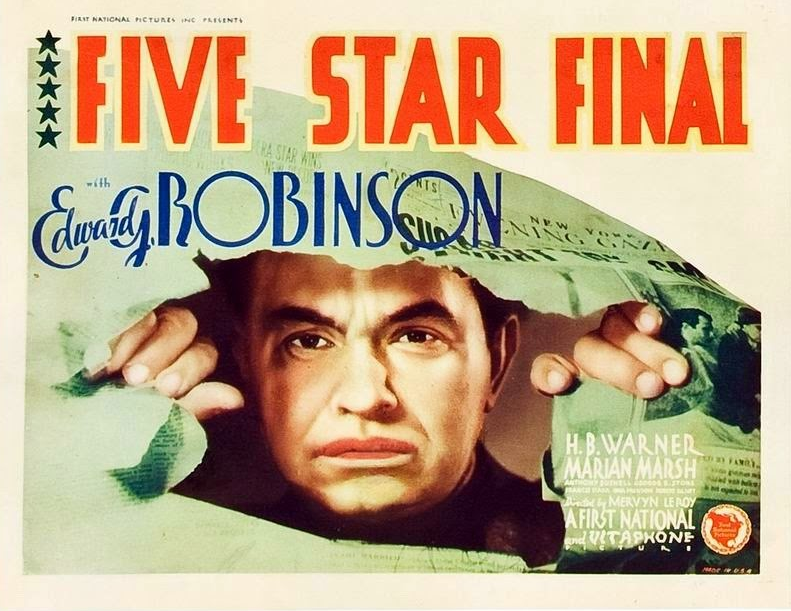 If you think what passes for today’s “news” reporting is sketchy and lurid, 1931’s excellent potboiler Five Star Final will show you that the more things change, the more they stay the same. As with plenty of other pre-Code flicks, it’s got lots of surprisingly saucy dialog, a nice pre-noir vibe and some fine performances from a mostly great cast.
Featuring Edward G. Robinson in the lead role of a troubled newspaper editor, Aline MacMahon as his snappy-pattered secretary and a surprising turn by Boris Karloff as a lecherous reporter (he’s almost as frightening as he would be in Frankenstein later that year), this is one of those fast-talking, hard driving “message” films that slaps you back in your seat and holds you down as it spills out its guts about the crazy would of tabloid “news” and how it affects its subjects on all sides of the fence. While there’s an “on stage” element to certain scenes some may find sappy to a fault, I’d say that’s here to balance out the nastiness going on at that awful tabloid…
The New York Evening Gazette in the film is pretty much what a Rupert Murdoch paper crossed with TMZ would be today (ugh) as Robinson’s character, Joseph W. Randall deals with his job and his reporters often not so legal means of obtaining hot stories. Although he’s an old hat at the business, he’s grown weary of the seamy side of his business, particularly the race to the bottom his paper is in as it’s primarily a rag for the lower educated scandal-crazed public of the era. When his higher ups cook up the dumb (but lucrative) idea of doing a 20th anniversary series of stories on a famous (and yes, scandalous) murder, things come to a nice and foamy head with unsettling results. That murder was committed by a woman named Nancy Vorhees who killed the man who got her pregnant and refused to marry her, but now she’s a respectable socialite (Frances Starr) named Nancy Townsend with a beautiful daughter who’s set to marry into a wealthy family.
When creepy reporter T. Vernon Isopod (Karloff!) is sent to sneak about and gather information on the woman, his wearing of a clerical collar and preacher’s suit allows him access to the Townsend’s where he finds out all this and more before scurrying back to report his bid scoop (well, after celebrating with a few too many drinks at a speakeasy). Right after he departs, the Townsends realized they’ve been duped big time, but can’t stop the presses and the resulting chaos it spells for both families. The film wants you to feel these poor rich people getting chewed up and spat out by a past mistake and director Mervyn LeRoy gets plenty of mileage from his cast of veterans and relative cinematic newbies. He also gets in some stellar use of the split screen technique in a great pivotal scene where Mrs. Townsend is kept on the phone and left hanging as she calls to beg that the story get the axe.
Before the scandal hammer hits, the early Townsend sequences are florid enunciation from the actors and politeness with a side of cheeky smooching on the side by the soon to be wedded blissers Jenny (Marian Marsh) and Philip (Anthony Bushell). This homey, corny stuff sets up the Townsends as a family you want to empathize with, although I’d suspect some less sophisticated 1931 audiences might have cheered the rich family getting knocked down to street level as they took the side of the tabloid for not just going after their own class level. That said, it’s an interesting bit of drama to see the Townsend’s fate determined by a paper read by rubes who believe anything they see because it’s printed in black and white and is somewhat legible. But it’s also great watching Randall go from grumbling, half-willful accomplice to realizing his current job is a farce and his paper is a lot less about the truth and more about keeping circulation figures high and profiting off lousy content.
The film’s not to sex appeal comes from a new hire who Randall’s secretary says was hired for her breast size (using a hand gesture, of course) after the former gal was “fired for being flat-chested”. Yikes, someone call HR! No, wait… it seems HR was who let her go! Karloff pops up to leer at her and send a too cold breeze down your spine before he’s off to do his dirty work. While he’s a total letch (it seems as if he’s trying to look both up and down that new hire’s dress when they cross paths!), he also seems to be morally conflicted to some extent. His drinking binge before he stumbles back to the office seems to be driven partially by guilt (he’s a fallen minister turned reporter – gone from the good book to a bad one, I suppose), a terrible combination when one’s work is made up of making stuff up for a weekly fee.
By the time the end rolls around, there are a few revelations and it’s too late for a couple of characters caught up in the web that lousy newspaper has laid out. There’s no neat bow to wrap things up with here at all. Just some changes and decisions made that end up not changing much outside the walls of the Gazette save for the major shifts in the lives of the people scarred by what came before. Some things never change, I guess. Anyway, add this one to your viewing queue, get the popcorn popper going and settle in for 89 minutes of dynamite under your seat. Five Star Final’s a solid little gem of a film that’s still got a bit of punch to it.

 "DESTROY ALL FANBOYS!"