
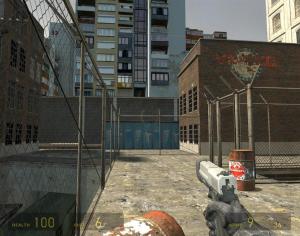
 Maybe it’s because I’m an artist (well, sometimes) but for the life of me, I just don’t understand how and why some gamers ONLY see “realism” as the sole way to go when it comes to modern game visuals while accepting all sorts of artistic stylization in comic books, TV and movies. Experimenting with stylization is not only important for artists in any medium, it’s also important for those who enjoy that medium to help expand their horizons, sometimes significantly. “Realism” is as subjective as looking out your own window and seeing what an actual building, tree or person looks like (boring, aren’t they?), then comparing it to whatever game you’re playing that’s blowing your mind out your left ear.
For me, the best looking games aren’t all (nor always) the most realistic. Having grown up playing everything from the Odyssey and Atari 2600 and way too many arcade games, I soon learned to love all sorts of art styles in 2D as well as 3D. That said, I love it when a developer is able to as perfectly as possible capture the most mundane objects we take for granted and keep them as boring as they look as we pass them on the street. Paradoxically, it’s in these “boring” looking games that I get the most enjoyment, poking around in nearly every nook and cranny possible just to see how much the artists and programmers were able to keep things real (even with a bunch of fancy lighting effects and the occasional alien or zombie strolling about). To this day, Valve’s Half-Life 2 is one of my favorite “go-to” games when I want to show someone new to gaming some work that’s believable and realistic while also packed with originality that crosses into different genres.
Of course, I’m ancient enough to recall conversations from nearly every gaming era where someone was babbling on about hating a certain graphics style. I’ve heard it all, from how “crappy” Atari 2600 games looked compared to their arcade counterparts, to whining about how vector graphics were too ugly to Nintendo versus Sega 8 to 16-bit graphics, an actual conversation about why we needed 32-bit consoles with their pointy polygons and even how too much texture smoothing out ruined PC and N64 games. While some parts of each argument made a bit of sense, an expansion of one’s sense of wonder goes a longer way in assistance than does simply picking apart a visual style or overuse of certain technologies, I say.
Well, most of the time – I still dislike a lot of PC and N64 games for being too damned smooth to the point of eyeball-shaking blurriness. Voodoo powered graphics? More like doo-doo powered graphics that had me reaching for the aspirin after an hour or so of play…

 "DESTROY ALL FANBOYS!"